
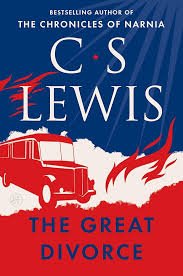
There are books you read and move on from… and then there are books that stay with you. The Great Divorce by C.S. Lewis is one of those.
At first glance, it’s a simple idea — a bus ride from a grey, empty town to the edge of Heaven. But it doesn’t take long to realize this isn’t really about the afterlife as much as it is about the condition of the human heart right now.
What Makes This Book Hit Differently
Every person in the story is invited to stay in Heaven. No one is forced out. No one is turned away. And yet, most of them choose to leave — not because they can’t stay, but because they won’t let go of something else. Pride. Control. Being right. Even their own pain — they are self-absorbed with whatever put them in the grey city in the first place.
That’s where it stops being theoretical.
Jesus says in Matthew 7:13–14 that the way to life is narrow. Not hidden — just narrow. And Lewis brings that into focus. The barrier isn’t access. The barrier is surrender.
Hebrews 12:1 tells us to “lay aside every weight, and sin which clings so closely.” What this book exposes is how often we carry those things longer than we should — sometimes without even realizing it. Not just obvious sin, but the quieter ones. The respectable ones. The ones we justify.
The Part That Lingers
There’s a moment in the book where a man is faced with giving up something that has defined him for years. He doesn’t negotiate with it. He doesn’t manage it. It has to go. Completely.
And that’s the part that lingers.
Because if we’re being honest, most of us are fine with partial surrender. We’ll give God the visible areas, the manageable ones — but hold onto the parts that feel too personal, too ingrained, too costly. Another part of the story has a man who is visited by someone he knew very well in life and attempted over and over to just have him come with him to the mountains, but the man couldn’t rationalize this place — couldn’t rationalize leaving what he knew for something better and ultimately in the end chose to go back to what he knew instead of everlasting glory. How truly sad to be that close and still deny the truth.
Luke 9:23 makes it clear — deny yourself, take up your cross daily, and follow Him. Not selectively. Not when it’s convenient. Daily — for we are not guaranteed tomorrow.
More Than a Story — A Mirror
What Lewis does so well is show that you can be close to truth and still walk away from it. You can stand at the edge of something better and choose what’s familiar instead. But isn’t that just human nature — we get stuck in our own thoughts, lost in our bad decisions, and can’t find our way out even though Christ is there all along saying here is my hand, just take it.
And that’s where this becomes more than a story — it becomes a mirror.
As men — leaders, husbands, fathers — that reality carries weight. Because the direction of our lives doesn’t just affect us. It shapes what others see, what they follow, and what they come to believe.
Joshua 24:15 says, “Choose this day whom you will serve.”
That’s what this book ultimately presses on. Not someday. Not in theory. Today.
So the question it leaves me with is simple, but not easy:
What am I still holding onto that God is asking me to release?